|
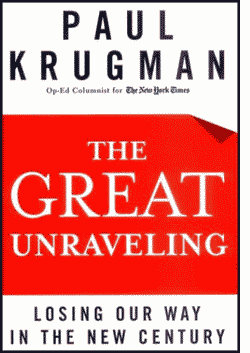
The Great Unraveling
Losing our way in the new century. An excerpt from the book.
- - - - - - - - - -
by Paul Krugman
Introduction
 ETAPHORS can be tricky things, but Manhattan's "debt clock" is as good as they come. ETAPHORS can be tricky things, but Manhattan's "debt clock" is as good as they come.
A public-spirited businessman installed the clock in 1989, hoping to shame politicians into acting responsibly. Huge numerals counted off the ever-rising national debt-ever-rising because each year the federal government spent far more than it took in, and was forced to borrow the difference. But in the late 1990s a funny thing happened: the government's tax take soared along with the stock market, and those mammoth budget deficits first shrank, then turned into record surpluses. In September 2000, the owner of the clock pulled the plug.
In July 2002, with the nation once again facing deficits as far as the eye could see, he turned it back on.
There's much more to recent American history than the way the federal government declared victory in its long struggle against deficits, only to see the red ink quickly return. But as the budget went, so went many other indicators of our national well-being. In the early 1990s we were a depressed nation, economically, socially, and politically: a best-selling book of the era was titled America: What Went Wrong. By the end of the decade we had, it seemed, pulled ourselves together. The economy was booming, jobs were plentiful, and millions of people were getting rich. Budget deficits had given way to record surpluses. The long crime wave that began in the 1960s came to an end; major cities were suddenly, amazingly, safer than they had been for many decades. The future seemed almost incredibly bright.
Then the good times stopped rolling. By 2003, the fabric of our economy-and, perhaps, of our political system and our society-seemed once again to be unraveling. The nation was gripped by anxiety, with polls showing a majority of the public feeling that the country was headed in the wrong direction.
This book is, first of all, a chronicle of the years when it all went wrong, again-when the heady optimism of the late 1990s gave way to renewed gloom. It's also an attempt to explain the how and why: how it was possible for a country with so much going for it to go downhill so fast, and why our leaders made such bad decisions. For this is, in large part, a story about lead-ership-incredibly bad leadership, in the private sector and in the corridors of power. And yes, it is in particular an indictment of George W. Bush. Helen Thomas, the veteran White House correspondent, has called Mr. Bush "the worst president in all of American history." I'm not sure about that-he has some stiff competition. But the really terrible presidents of the past led a nation in which presidential incompetence and malfeasance mattered far less either to the nation or to the world than it does today.
Most of this book consists of columns that I wrote for The New York Times between January 2000 and January 2003. I hope that readers will find that the sum is more than the whole of its parts-that taken together these columns tell a coherent story. I'll talk shortly about how I came to write those columns. But first, let's recall the background.
 Next page | The Dreary Years Next page | The Dreary Years
1, 2, 3, 4, 5
|