|
Lunch With The Fat Man | 1, 2, 3
"Getting Perfection Using What You Have"
Hi. Sit down. What are you having? Welcome to Lunch with the Fat Man.
How do you burst a perfectionist's bubble? Buy him a watch.
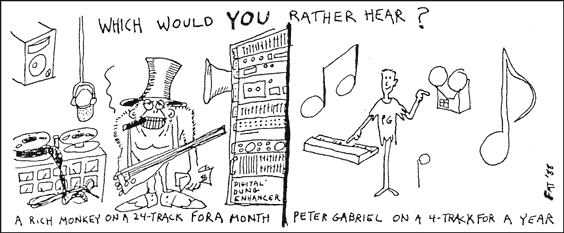
Sure, the Fat Man's being a little oblique here, but the point is that perfection, even by the most skilled person in musical production, means nothing if it needs to be done within a certain time frame (or money frame), and isn't. Given enough time and money, anyone can be a perfectionist. Therefore, the pursuit of perfection is open not only to the very skilled and the very rich, but to those with no immediate time constraints.
How can you increase your odds of achieving perfection?
Let's assume you aren't very rich, and suppose you have some extra time on your hands. Just to round out your fortunes, you have no recording contract. Good for you -- no contract means no deadline, and time, if used correctly, can be an acceptable substitute for skill. All aright, all right, it can enhance the great skills you already have, you genius, you.
By spending a lot of time writing, and playing with overdubs on a 4-track recorder, you can accomplish huge amounts of musical headway, composing and creating unique and vital music, which is the source of all good things. It might get you a real contract, say, one that includes more than one album, rather than a less desirable, easily achieved one. It might get a skilled producer interested in working with you. It might give you enough material that you can come up with a second album, even though you're touring when you're supposed to be writing it. These results only come from good musical growth and creation, which are things you can't get in the big expensive studio because you can't afford it. But even if you could afford it, there would be better things to spend your money on.
The only thing a good 24-track studio can give you is tone -- it can't give you music. While tone is important, it is overrated. Any engineering genius, and there are lots of them, can give you a wonderful tone, and record companies know this. Focus your search for perfection on the music rather than the tone, and you will cut down both your time and money requirements, and achieve a better piece of art. Then, when you get signed as a result, you'll see how easy it is to polish the sound.
Another approach to achieving perfection is by lowering your standards of perfection. There are two ways to do this -- the right way and the wrong way. The differences are subtle, but careful study will reveal that good art triumphs in the right way, and laziness and image-consciousness triumph in the wrong.
Right: “WOW! That was the best solo he ever played, even though he missed the intro. I don't think he could outdo it. Leave it in."
Wrong: “Wow! He missed notes on half of his solo! That's really great, because the Beatles miss notes! Leave it in!"
Right: "I've always liked The Cramps, and we were lucky that we sort of sounded like them from the first time we played together."
Wrong: "When we played together for the first time, it sounded like The Cramps, so we decided we're going to be the Next Cramps."
Right: "I think the piano leakage makes it sound a little richer."
Wrong: "I think the piano leakage makes it sound like Little Richard."
Right: "We're out of time -- either leave out the solo or try something simpler."
Wrong: "Close enough for Austin."
Say. This was great. Let's have lunch more often.
 Next page | "The Next Beatles" Next page | "The Next Beatles"
1, 2, 3
|