|
Lunch With The Fat Man | 1, 2, 3
"Surviving the Music Store"
Hi. Sit down. What are you having? Welcome to Lunch with the Fat Man.
This is a column of philosophy and dogma for the recording studio. From time to time it will seem to the minds of the less fat of my readers that I wander from the subject, but it is simply not so. This month's article, for instance, might evoke such thoughts, but let me assure you of the germane nature of this subject. Not only will every musician have to go into a music store at one time or another in order to purchase the tools of the trade, without which recordings become much quieter and slightly worse, but once a general comfort and ease in the music store is achieved, the same comfort in a recording studio will become much easier to achieve. It makes a great deal of sense to practice your "musician under the scrutiny of other musicians and music professionals" act in the music store environment, since you have to be there anyway, and, like the studio, your success depends on your building good communication while staying in touch with your artistic goals, and keeping cool under pressure. And in both places, you're probably spending and average of about $80/hour.
The challenges of the music store can be characterized by two situations. To bring these to life, let's illustrate by example:
Early experiences can be the hardest. The younger musician knows only that he must own an instrument to be the person he wants to be, and he has only the vaguest notion of salesmanship and how it works. Perhaps this notion takes the form of a curiosity about Saturday morning cartoons, and how they all seem to about a toy, game or candy.
He enters the store. He's greeted by the disorienting sounds of thirty or forty people playing all of their fastest riffs at once on the wildest, most effects-sweetened instruments he's ever heard. Suddenly he sees, just beyond the "Don't Touch, Ask A Salesman" sign, the very object of his desire, say, a blood red Charvel with a koa wood neck and some kind of hip replacement pickup. He's transfixed. It's all he's dreamed about through countless hours in class. He sweats a little. He feels through his pockets to see if he brought a pick. Starting to reach up for this surfboard-finished work of perfect craftsmanship (a very personal and important moment in his relation to the instrument, and, therefore, to his life ahead as the greatest instrumentalist the world has ever known) he hears the biting words of a salesman just above and behind him.
"Thinking about buying something today?"
I must mention here that this phrase is not from any Texan stores, but has been said so many times in LA's Guitar Center that an easy 3/4 of the world's guitar shopping sprees have started with it.
So here we have the first challenge; establishing a working dynamic with the salesman, who seems to be of a very different state of mind than the potential buyer. This can be solved, but only with a two-way path of understanding, both paths of which are created by you, the buyer.
First the salesman must be made to understand that you might not buy anything from him, today or ever, but that the help he gives you will increase the odds that you will buy from him when you do buy. In order for him to understand this, you must make it true. You must think in terms of dollars per hour that his time is worth, and consider that if another store offers you a slightly better deal than his does, you'll add his worth as a salesman to the price you'd pay at his shop. Remember the Great Fat Motto -"Your Dollar is Your Vote." If you spend all your money at McDonalds, there will be lots of McDonaIdses, and all of the little burger shops will close down. Oh, I see you already have.
The second thing that must be understood is that you must know that the salesman is not just a money-hungry jerk out to get you and your allowance. No, no. He may just be that, but he's also much more. He's a man. Or he's a woman. He's a man or woman who goes to work daily to try to make a living. He's probably a musician who's big-time stardom is either still just around the corner after 20 years, or lying crushed in the "Mighty Room Full of Keyboards." Salesman was a distant second career choice for him and, like you and everybody, he is dealing with his own sense of self-worth in an unpitying world, and trying to scrape together a little respect from his peers. At work he is judged on many levels, not the least of which is how much stuff gets sold while he's working. So respect that, cut him some slack, and help him do his job efficiently by not eating up a lot of his time, not calling him an ass-bite to his face or behind his back, and not wearing your rodeo-sized belt buckle when you play the Kramers.
Now the second situation, illustrating the second main challenge in surviving the music store:
Back to our lad with the toy-lust. He's got the beautiful crimson phallus plugged into an amp twice as big as any he's seen, with the volume high and the knobs all adjusted to God-Knows-What by the salesman, who, with any luck, isn't going to continue to twist knobs the whole time our boy plays. The cacophony of fast riffs from the other customers still pervades the air, but now it seems like the room is full of Roy Clarks and Django Reinhardts on speed. One pluck of an E string and all eyes will be on him. Yet he's only been playing for a year. The question, (and this one is much more crucial than that of personal relationships with the salesman): What do you play, when you're not as good as everyone else, and you don't want to sound like a fool?
Well, that's easy, but requires preparation. Once prepared, here's what you do.
First tune the guitar very carefully.
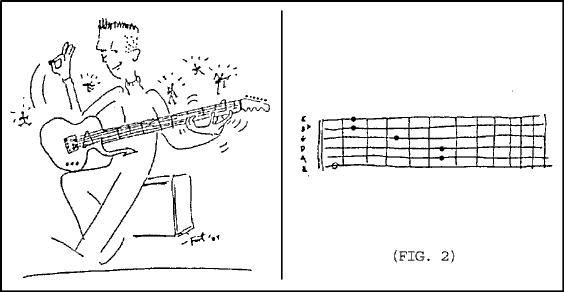
Second, play one fancy chord. Learning the chord is the preparation I mentioned. On guitar, my favorite is an E-Something that uses an open string, and stretches my hand over about seven frets. See Figure 2. I won't analyze its harmonic meaning, because it's a bit complex, and strictly depends on the chordal and melodic content in which the chord is to be used, which is, in this case, zip. Be that as it may, even if you take twenty seconds to position your fingers, once you strum this fancy chord, everyone will think you're better than they are.
Third, play the dumbest riff you can imagine. Theme from Green Acres. Woody Woodpecker. Old Spice. Hey, why dazzle 'em or baffle 'em when it's so much nicer to make 'em laugh?
Say this was great. Let's have lunch more often.
This article is dedicated to "Gene" Barbic, the Cal Worthington of Apex Music in San Diego. The way I understand it, he started as a keyboard polisher and, through perseverance, dedication, and constant pressure, became the greatest sales legend in history. Even though his immortal "What's your father going to buy you today?" and "I'd pay money to see your band" still ring in my ears, I remember him as a man who spent hours with me, taught me the advantages of 12" speakers and high wattage, and made it possible for me to afford a PA system. I think he's a king somewhere in the southern hemisphere now, but if you see him, tell him I'd like to buy him a well-earned beer.
Possibly to come: The music salesman who said "OK, $80 for the microphone, but I want you to know you're getting out of here like a bunch of damn bandits," "Guys who play Strats get laid," and "You couldn't afford it.".
 Next page | "Crackpot Beliefs" Next page | "Crackpot Beliefs"
1, 2, 3
|